
After Strange Gods
On the Enchantments of Art, Fantasy, and Magic - Part 1

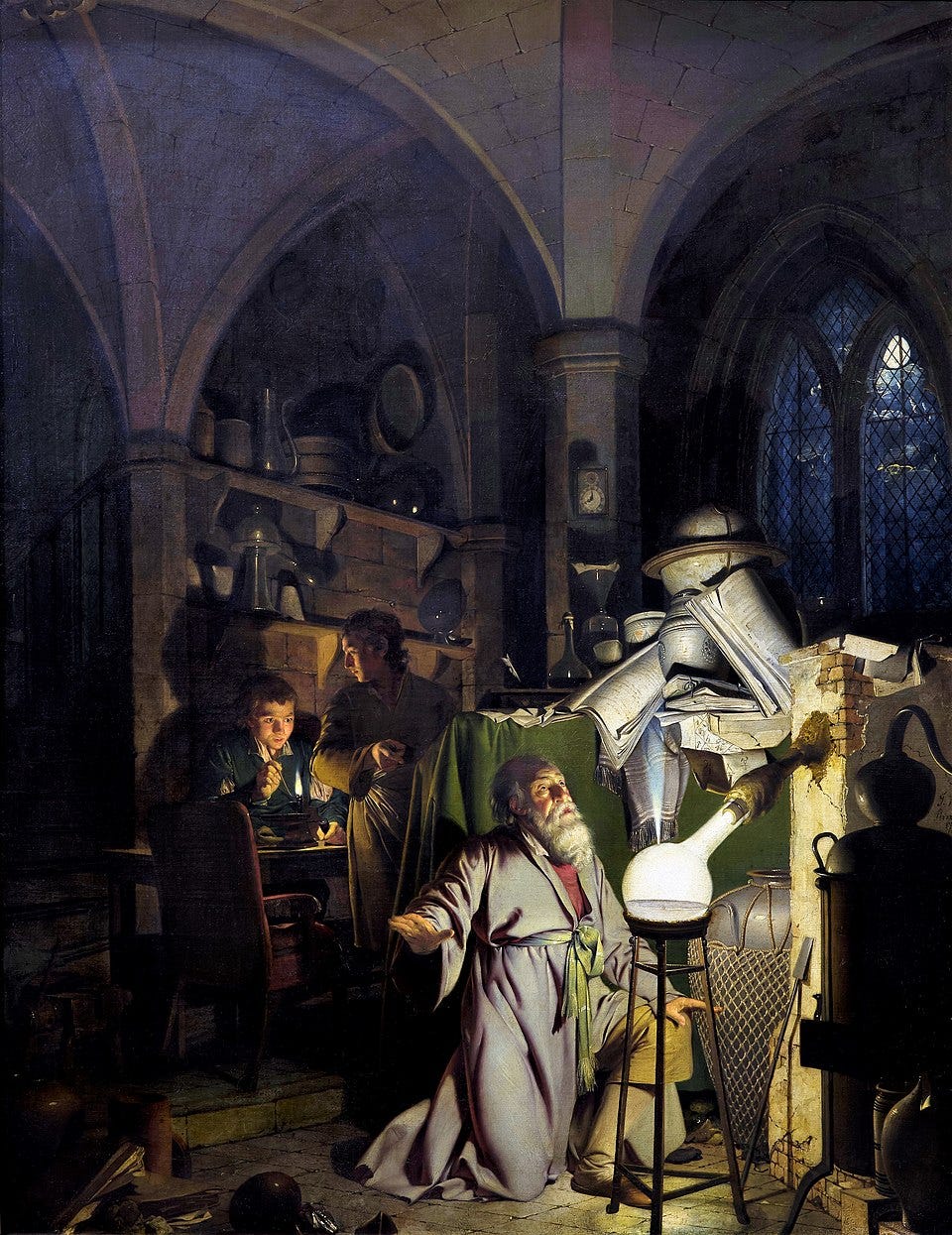
The Alchemist Discovering Phosphorus (1771) by Joseph Wright of Derby, in Derby Museum and Art Gallery
There is nothing quite so modern as magic. While the statement might seem paradoxical, magic intrigues Western man at key shifting points in the development of modernity, from the Renaissance onwards. It’s usually assumed that, rather as the sleep of reason brings forth monsters, a waking reason puts to sleep the mythical beasts in their feeding grounds of magic and religion. The recent New Atheists thought thus, as do other adherents of what they deem traditional Enlightenment principles. Earlier in the twentieth century, influential studies such as the social historian Keith Thomas’s Religion and the Decline of Magic (1971), tend to follow the ‘disenchantment of the world’ thesis of Max Weber, elaborated in his famous lecture of 1917. They show the draining out of magic from religion in the early modern period, under the influence of the Protestant Reformation, and its project to produce a more rational religion than obtained in the obscurities of medieval Catholicism. It’s a project that is paralleled in the political reading of the ‘Whig interpretation of history’, whereby reason and knowledge progressively extend the principles of tolerant, liberal democracy. But magic persists rather stubbornly, despite the presence of the spread of enlightenment, and the study of its theory and practice, especially when adjacent to religion, continues to be both popular and controversial.
Even Keith Thomas noted that a practical interest in astrology remained among some Protestant Reformers, who otherwise ranged themselves resolutely against superstition. The sociologist of religion, Peter Berger, in his incisive study, A Rumour of Angels: Modern Society and the Rediscovery of the Supernatural (1969) noted that despite the prevailing intellectual view that belief in the supernatural was no longer possible, this did not actually correspond with the experience of considerable numbers of people in the late 1960s. The ‘disenchantment of the world’ thesis itself has been thoroughly critiqued by sociologists and historians since the end of the twentieth century, and Michael Saler, for example, in his persuasive 2006 article, ‘Modernity and Enchantment: A Historiographical Review’ suggests that, while modernity is rather enchanted by the idea of disenchantment, which provides such a strong and convenient intellectual model for historians of ideas, and while there are certainly aspects of disenchantment in the modern world, modernity also has discernible forms of enchantment, too. The modern world is possessed, he concludes, of an antimonial position, wherein disenchantment and enchantment sit side by side.
Much depends in this discussion, of course, on what we mean by enchantment and magic, but on the face of it, the case that the modern world is disenchanted seems still strong. We are surrounded by the barren fruit of impersonal, rationalistic utilitarianism wherever we look: hideous, functional buildings made of rebarbative materials; ubiquitous technology, the noise, glare, and smell of which work constantly on our senses ; transactional and dysfunctional relations (‘Computer says no…’ ) in what barely passes for civil society – all manifestations of the machine for living in which is the world we have made since the scientific revolution of the seventeenth century. Despite its less than satisfactory appearances in late modernity, we still cling to the principles of this revolution. We place our trust in its claims of predictable cause and effect, and accept its authority (just about, perhaps, after Covid) like nothing else. We benefit from its mitigations of disease and distress; we press the button, and things go. Yet has this ever been everything to us? Has it ever been enough? It’s perhaps here why the lure of magic is not eradicated by the growth of knowledge, technology, and rational inquiry, but rather follows them around, lurking in the shadows, waiting to step in when they don’t quite satisfy.
Although the elite standpoint became well established, since the Reformation onwards, that magic only appeals to the ignorant and the simple, the fascination of what we might include in the word ‘magic’ has always been felt by some of those at the intellectual cutting edge of their times. Marsilio Ficino and Giordano Bruno in the Renaissance; Isaac Newton in the Enlightenment; the Theosophists and Spiritualists, including Arthur Conan Doyle, of the nineteenth century; the occultists like W. B. Yeats in the early twentieth century. A recognition that valuable knowledge of the natural and supernatural, if hidden, world might be found in magic persisted alongside more conventional forms of ‘science’, even if this was partly a reaction against the grey and lifeless machine world coming into being. Perhaps, too, it was simple, and rather idle, curiosity about strange and intriguing things. As T. S. Eliot puts it in The Dry Salvages:
To communicate with Mars, converse with spirits,
To report the behaviour of the sea monster,
Describe the horoscope, haruspicate or scry,
Observe disease in signatures, evoke
Biography from the wrinkles of the palm
And tragedy from fingers; release omens
By sortilege, or tea leaves, riddle the inevitable
With playing cards, fiddle with pentagrams
Or barbituric acids, or dissect
The recurrent image into pre-conscious terrors—
To explore the womb, or tomb, or dreams; all these are usual
Pastimes and drugs, and features of the press:
And always will be, some of them especially
When there is distress of nations and perplexity
Whether on the shores of Asia, or in the Edgware Road.
While, as moderns, we like our world to be knowable, predictable, and manageable, things can fall apart, and are perhaps never entirely secure. Magic can be an alternative route to those same ends promised by reason, science and technology: the promise of power, over nature and other people.
Magic can mean, simply, wonder. A magical evening has glamour, romance, and excitement, easily reproduced on the stage or screen. Magic is the colour and sparkle that alleviates the weight of the drabness of the everyday. Similarly with enchantment, as in ‘some enchanted evening.’ The evening with the Ouija board is perhaps just a further step away from the boredom of the machine world, and an attempt to connect in a world of fragmentation. This is the world that Eliot describes in The Waste Land, where the lost, atomized individuals look for meaning in Madame Sosostris’s ‘wicked pack of cards’. Here, the occult is one more thing that can be purveyed on the ever-expanding stalls of the consumer society, and those for whom the rational world is no longer knowable, predictable and manageable, seek a different knowledge, other observable patterns, and channels of influence – all of which come through gnosis.
The failure of reason brings forth wonders, and gnosis has exterior as well as interior attractions. In the fluid impermanence of modern social structures, the initiate becomes a member of the chosen few, the illuminated elite, a special and perhaps secret society that communally affirms the truth of the secrets entrusted to it. Magic meets and swiftly dispatches alienation, boredom, and anomie, by giving meaning to the individual and the cosmos. And magic works in this way not only for the mystery cults but also for Harry Potter, who experiences (as a classic orphan figure of children’s fiction) the alienation which is also the experience of adolescence. These books are magical in the sense of containing wonders: of imagination, fantasy, colour, and spectacle – features that make them effective film drama, too. How many children’s (and adults’) lives have not been made more enchanted by the Harry Potter stories?
The Harry Potter stories contain magic in another sense: magic as technique. While this can be part of the wonder of magic and fantasy, it is also distinct from it. This is magic not just as a frisson, a world of imaginative possibility, but rather as a practical means to certain ends. The end of magic in this sense is not simply enchantment, the evoking of a sense of wonder, but power and control. This is the magic of the magician, not of the disciple, or the ‘muggles’ who watch the film in delighted wonder, rather than involve ourselves in the action. In his essay On Fairy-stories (1947), J. R. R. Tolkien makes a similar distinction: ‘Enchantment produces a Secondary World into which both designer and spectator can enter, to the satisfaction of their senses while they are inside; but in its purity it is an artistic desire and purpose’. Author and reader (or audience) are having fun, even of an elevated kind, depending on how we rate the Harry Potter book as examples of their literary genre.
This state of things (‘enchantment’), Tolkien distinguishes from magic, which is a word, he says, which ‘should be reserved for the operations of the Magician’:
Magic produces, or pretends to produce, an alteration in the Primary World. It does not matter by whom it is a said to be practised, fay or mortal, it remains distinct from the other two [Art and Enchantment]; it is not an art but a technique; its desire is power in this world, domination of things and wills.
This is the technique (or craft) of the séance medium, the fortune teller, the reader of cards, the cult leader, and so on. Most of us, in the real world, do not wish to be ruled by such people, however we might enjoy them, usually in fantasy and horror films and novels. Most sane people prefer their magic at some remove.