
'All's Whiggery Now'
On Tory Loyalties and Catholic Faith

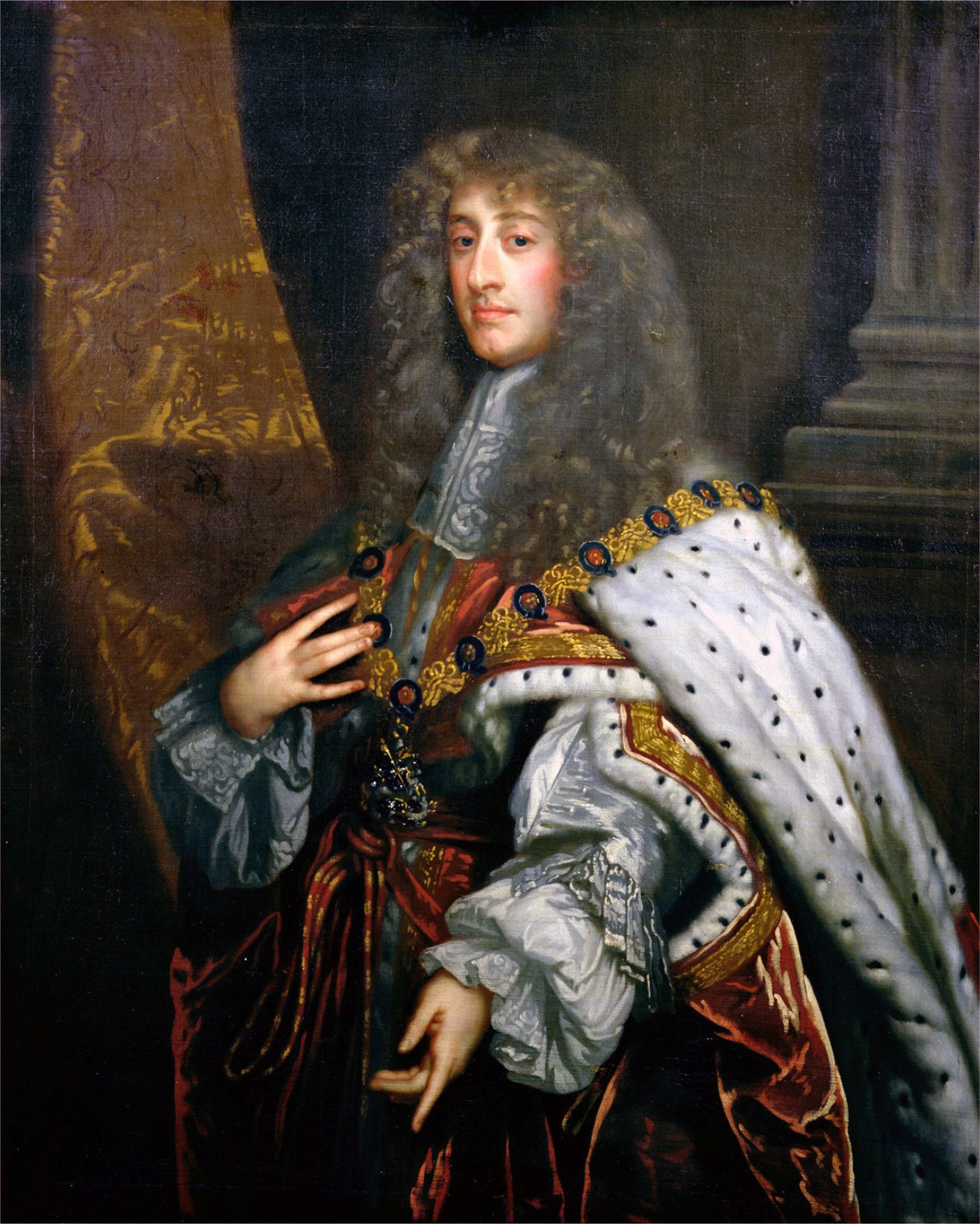
Good King James (II of England and VII of Scotland), by Peter Lely
William Butler Yeats, the Irish poet, was in 1933 disheartened at the course the new Irish Free State was following. His nationalist dream of an Ireland dedicated to the high true things of art and beauty, as opposed to the low commercial materialism of contemporary Britain, seemed to have evaporated under De Valera’s Catholic but middle-class direction. Ironically, given the origins of the word, as a term of abuse for extreme and fractious Protestant Scottish covenanters, Yeats identified the course of the new Catholic state as ‘Whiggery’. In his poem, ‘The Seven Sages’, Yeats is precise about what the word means to him, and he includes four representative opponents of it from Irish Anglicanism:
The Sixth: Whether they knew it or not,Goldsmith and Burke, Swift and the Bishop of Cloyne
All hated Whiggery; but what is Whiggery?
A levelling, rancorous, rational sort of mind
That never looked out of the eye of a saint
Or out of drunkard’s eye.
The Seventh: All’s Whiggery now,
But we old men are massed against the world.
The First: American colonies, Ireland, France and India
Harried, and Burke’s great melody against it.
Edmund Burke, a Whig but also the founder of modern conservatism in his reaction to the French Revolution, consistently opposed the abuse of political power and its brushing aside of traditional religion, old custom, and established rights. Oliver Goldsmith, in his poem ‘The Deserted Village’, lamented the passing of traditional rural society through the greed of the wealthy. Jonathan Swift, most memorably in Gulliver’s Travels, satirised the lunacies of Enlightenment rationalism, and aligned himself with the Ancients against the Moderns. Bishop Berkeley, in Yeats’s estimation, provided a theory of vision more true to reality than the arid materialism of Newton and Locke. Yeats’s four horsemen, riding against the modernist apocalypse, express the poet’s idea of an intellectually independent Ireland, based in an Irish Toryism of the Established Church and old aristocratic, landed families. But he had already written, twenty years before, in the poem ‘September, 1913’: ‘Romantic Ireland’s dead and gone’, become instead (like England, at least to Napoleon) a nation of shopkeepers, who ‘fumble in a greasy till’, their imaginative vision lost.
It is one of history’s many ironies that Catholics in Ireland, as in Britain, should have received their Emancipation from the penal laws through ‘Whiggery’ and its successor, Liberalism, a mode of thought with which Catholicism has little in common. It was an irony that St John Henry Newman tells us was not lost on his Tory friend, and High Anglican collaborator, John Keble, reacting to Catholic Emancipation in Britain in 1829: ‘...it grieved and offended him that the “Via prima salutis” should be opened to the Catholic body from the Whig quarter’. High Anglicanism, however, has not always been so friendly to the Church of Rome (consider the High Anglican Liberal, W. E. Gladstone) but such are the complications of ideas and loyalties in the real world. On the face of it, Catholicism is the antithesis of Whiggery, the ‘levelling, rancorous, rational’ mind in Yeats’s summary. Whiggery, as it turned into Liberalism, was to become perennially obsessed with the destruction or – at least – the buying out of old hierarchies, jealous of place and authority, and then enchanted by the cant of the French Jacobins, to embed the abstractions of liberty, equality, and fraternity into British politics, where they could work away like acid to the present day, precipitating apparently endless capacities in people for greed, envy, and lust. Whiggery never looked out of the elevated eye of the saint, or the more terrestrially-founded elevations of the drunkard, and the glories of the romantic medieval world are closed to it. Instead, it makes its home in the modern world of restless individualism, senseless consumption, frantic acquisitiveness, and dissolution of soul.
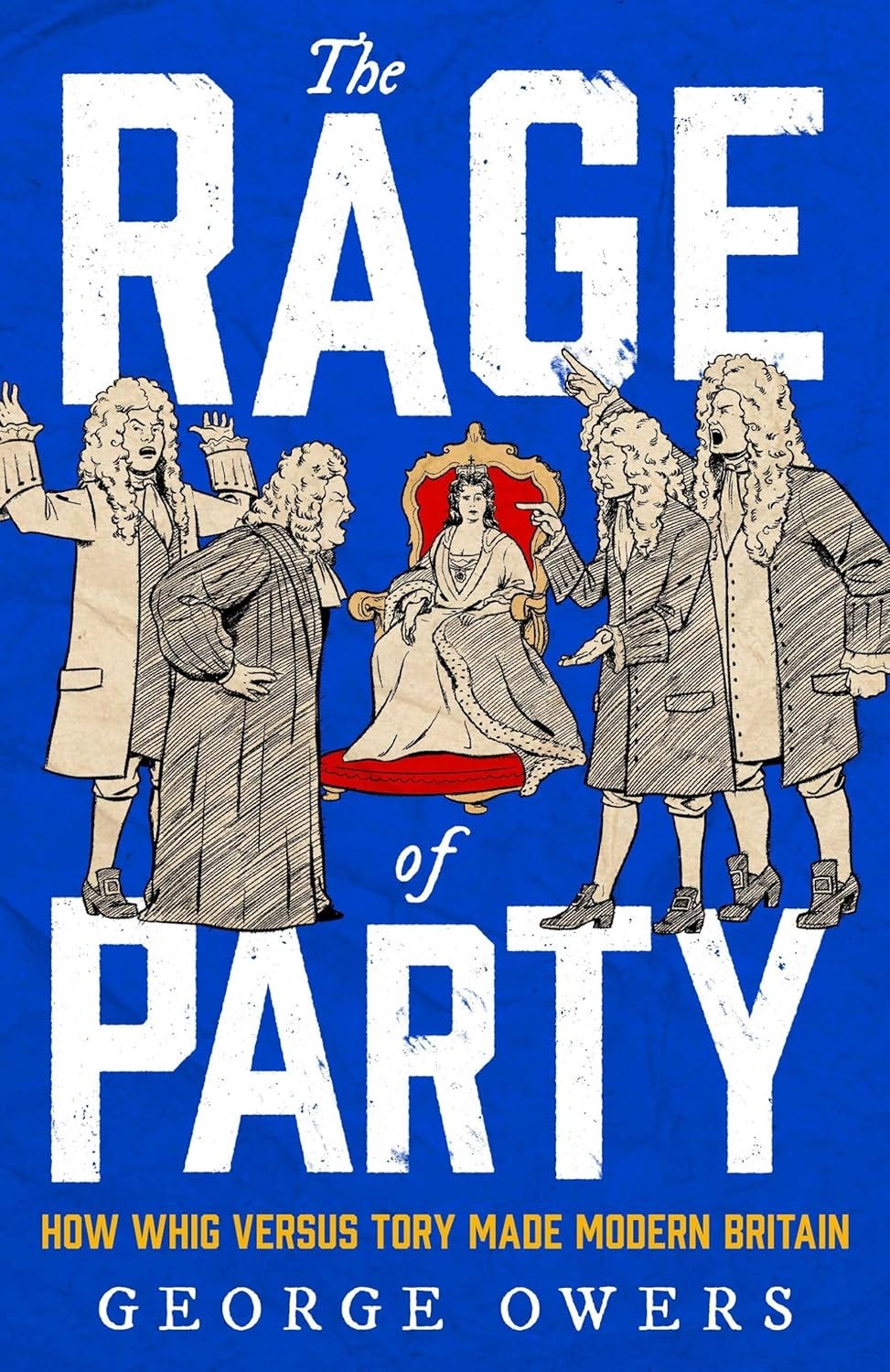
I recalled Yeats’s lines on reading, recently, George Owers’s excellent new book, The Rage of Party: How Whig Versus Tory Made Modern Britain. The author looks closely, but within a brisk and compulsive narrative, on the years 1689 to 1714, from the Glorious Revolution to the death of good Queen Anne; at the struggle between Whigs and Tories after the Exclusion of the last Catholic king, James II, including the ever closer tying of English and Dutch interests with the accession of the Prince of Orange, as William III; and at the enormous increase of state power, attendant on massive European military entanglements. By the end of this period, with the death of the Tory-sympathetic Queen Anne, effectively the last of the Stuarts, the Whigs had won the struggle for power, and would dominate eighteenth-century British politics until the accession of George III in 1760. George Owers shows how significant for the establishment of the modern world the years after 1688 were. The great Whig lords took control of the Crown, to establish an oligarchy, with Britain a monarchy in name only. In 1694, in the middle of the Nine Years War with France, the Bank of England was established, along with Dutch banking methods of a national debt and low interest rates. England could now supercharge the Dutch wars abroad, with Tory landowners footing the bill through a land tax. The bankers were, of course, Dissenters and fellow Calvinists to the Dutch, and drove the new financial-military complex that underpinned Britain’s later involvement in the War of the Spanish Succession (1702-1712). Whig oligarchs like John Churchill, 1st Duke of Marlborough, could then amass huge personal fortunes through protracted warfare, and build monuments to Whig power such as Blenheim Palace.
George Owers shows, too, how the legacy of the culture war between Whig and Tory is still very much with us. ‘Brexit was’, as he says, ‘a classic conflict between Tory nationalism and Whig cosmopolitanism’. But since the division between Tory and Whig actually goes back to that between Royalist (and Anglican) and Parliamentarian (and Puritan) in the Civil Wars, the positive side of the emergence of the party system was that these tensions came to resolve themselves in verbal rather than bloody conflict – at least until now. Along with parallels to our current tensions between nationalism and cosmopolitanism, we also hear the debate on immigration. In 1709, there was a large influx of refugees, from the Palatinate of Germany, displaced by war. The Whigs were welcoming: these were sound Protestants, and perhaps economically useful like the earlier Huguenots, who would help commerce and further the kind of social change that suited the Whigs’ larger cultural project: a real fore-echo of Blair’s Britain, and the Liberal Conservatives who followed him. The populist consequences of the Whigs’ policy are familiar too. Charitable handouts and jobs for the native English poor were scarce after years of hugely expensive warfare, and a feeling that the ‘Poor Palatines’ were unfairly prioritized: a two-tier England, in effect. Despite Whig idealism, the German immigrants were not only poor, but low-skilled, and most soon went back home. The resentment of Tory landowners that their land taxes were being used to pay for Whig wars and the growing wealth and influence of Dissenters, who had no responsibility in the social order, reflected a wider view of injustice: that Whiggism meant using other people’s money to pay for a political vision of constant war, public debt, and individual greed, with free movement of people promoted by war, and free public money. It all sounds so familiar.
The Rage of Party shows how the period 1689 to 1714 was the completion of the Civil War process whereby, ‘England was transformed from a country that was in some respects still a late medieval state, in which the monarchy and the Church remained the most fundamental sources of authority, to a country transformed by the dynamic forces of liberal modernity, on the cusp of capitalism, representative government, religious pluralism and empire’. This was the world which the Whigs desired, and one which was only possible if monarch and Church were diminished or under the control of those with money rather than land, and power from banking and warfare rather than from the old settlement of land, custom, and constitution. The Tories, by contrast, feared that the combination of war, taxes, debt, and Dissent,
would drag the Old England they knew into the murky depths of chaos and instability. New dynamics – of religious pluralism, impersonal financial transactions and growing state power – would undermine the stability and morality of an agrarian country governed by the authority of squire and parson and create an uprooted, uncertain commercial society in which all that was solid would melt into air and all that was holy would be profaned.
Who would say that the Tories were wrong? They couldn’t even rely on the King (the fons et origo of authority and stability for the solid Royalist), with a Dutch Calvinist, imported by the Whigs, occupying the English throne. None the less, the Tories steadily aimed for ‘peace, low taxes and securing the privileges of the Church’, exercising their influence during these years where they could. It was not inconsiderable, especially under the leadership of honourable and industrious Robert Harley; a number of MPs during these years were Tories, and in Owers account, a surprising number of them were Jacobites, or sympathetic to the Stuart cause, which wouldn’t be finally settled until 1745, with the defeat of the Young Pretender. By 1714, however, the Tories looked dead as a political force, and had to wait until 1760 until they would find royal favour, and power, once more.
We can see how the struggle of the years 1689 to 1714, between the old world and the new, is identifiable, too, in the later political conflicts, of the eighteenth and nineteenth centuries, as well as in our time. It was to have a significant role in the American War of Independence, as Dr Samuel Johnson, that great Tory and Jacobite sympathizer argued: ‘...the continent of North America contains three millions, not of men merely, but of Whigs, of Whigs fierce for liberty and disdainful of dominion’. Unlike Burke, Johnson had no sympathy for the rebellious colonists. For him, the devil was the first Whig, and Whiggery was Luciferian pride and unrestrained self-interest. American Whig talk of liberty was cant: ‘...how is it that we hear the loudest yelps for liberty among the drivers of negroes?’ Whig liberty was for unrestrained appetite, the plundering of the public purse, and the freedom to enslave other human beings. The Whig success in the American Revolution meant that formal Toryism, as loyalism, was confined to Canada, despite the continuity of conservative ideas among some of the American founders. Thereafter, the tensions in the American system, that were to explode in the War Between the States, reflect the distinctions that were emerging in the later eighteenth-century Britain, between the Old and New Whigs, between conservatives like Burke, and radicals like Charles James Fox. In the twentieth century, America would become the great engine of world-wide Whiggery, or Liberal Democracy as it was by then known. It was for this time in the Western world that Yeats rightly said, ‘All’s Whiggery now’, whether conservative or radical.
Conservatism (and conservatism) has long been based on some level of accommodation of Whiggery, rather than real Toryism, and has involved, in practice, an application (cautiously at times, at others not) of Whig-Liberal aims. While these aims are often represented as humane ideals and values, in reality the interests they protect and advance are oligarchical. This was the great insight of Benjamin Disraeli, another writer of imagination, in his attempt to revive Romantic Toryism in the Peelite Conservative party of his day. In The Spirit of Whiggism (1836), a summary of his larger work, A Vindication of the English Constitution, Disraeli argued that the basis of Whiggism is not liberty but oligarchy, the rule of the few against the balanced traditional constitution which protects the interests of the many. Whig liberty, we may infer, is the liberty to exploit, and for others to be exploited: ‘liberalization’ of economy, finance, and cultural taste creates opportunities for the few to increase wealth and power by a general freeing of appetite, for goods and services, freed from the restraints of traditional morality. ‘The Whig party’, says Disraeli,
...have always adopted popular cries. In one age it is Liberty, in another Reform; at one period they sound the tocsin against popery, in another they ally themselves with papists. They have many cries, and various modes of conduct; but they have only one object – the establishment of an oligarchy in this free and equal land. I do not wish this country to be governed by a small knot of great families, and therefore I oppose the Whigs.
It was Disraeli’s genius to be able to articulate Toryism as an alliance of king, Church, and people against the lords, a kind of Tory democracy that might seem a good deal to some like populism, a commonwealth of real people against abstract ideas, such as ‘liberty, equality, and fraternity’. In reality, as Dr Johnson asserted, ‘Whiggism is a negation of all principle’.
How do Catholics and Catholicism, fit into this Whiggish world? As we have seen, Catholics benefited, and some then sought to benefit themselves, in their relations with the prevailing (if increasingly Liberal) Protestant atmosphere of the Anglo-American world. In place of persecution under penal laws which impoverished them, and excluded them from service to the commonwealth, Catholics gradually received toleration and means of economic advancement, even if they were never quite fully trusted, because of their perceived dual loyalty, to their own country and to a foreign power, the Papacy. The Catholic Church would, for a long time, hold out against the Liberalism which made the material lives of Catholics less painful, despite a number of attempts by some Catholic thinkers to find a common philosophy between Catholicism and Liberalism. It has been cogently argued that Liberalism eventually won that battle, too, in the Second Vatican Council, despite political and cultural Liberalism being anathematized by Pope Pius IX, in 1864, and reinforced by Pope Leo XIII in 1885. If Liberalism, then, is rejected as inconsistent with Catholicism, the traditional Catholic position looks much more like the Toryism of Dr Johnson’s Dictionary definition of a Tory: ‘One who adheres to the antient constitution of the state, and the apostolical hierarchy of the church of England’, especially in the Catholic interpretation of the true ‘church of England’. The High Tory view of the English state is much like the ‘throne-and-altar’ polity of Catholic integralism, that is, of mediaeval monarchy working in harmony with the Church established by law, since Christian kingship is a living (if vicarious) embodiment in human affairs of the Sovereign Kingship of Christ over the whole of the temporal order. The state of Liberalism in our time, as having shifted, to preserve or increase the power of the oligarchy, from religious pluralism to an active antagonism towards Christianity, is the inevitable and logical emergence of Liberalism’s innate tendency: where it is not forced by political circumstances to broker power bargains with religious minorities, it will actively promote (both against established and minority religion) anti-religious arguments, and secular, alternative belief systems, because they allow more room for oligarchy to exercise exclusive power.
While political Toryism in Britain, Ireland, and North America involved adherence to the Anglican throne-and-altar settlement, and thus a certain hostility to Roman claims (cf. T. S. Eliot: ‘I am sound High Churchman and [therefore] an enemy to Rome’), in practice Catholics would, until toleration, support Royalism (as in the English Civil War), as being more legitimate than the alternative. It is a reasonably parallel situation to Jacobite Tories like Dr Johnson, who thought James II ‘a very good king’, and William of Orange ‘one of the worst scoundrels that ever existed’, giving their allegiance to the Hanoverians. Dr Johnson acknowledged King George as his king as much for his own benefit as for King George’s. On empirical grounds there must be a king in England, and King George was a good sort of man to be king, in a properly constituted monarchy. A Tory moralist like Johnson would feel it essential to his own soul to be able to submit to a Christian monarch. Johnson could not, like a self-deluding Whig, submit to the sovereignty of abstract ideas; as St John Henry Newman said, Toryism is about loyalty to persons. We can also see a necessity in the Tory mind for hierarchical order, and a parallel in J. R. R. Tolkien’s saying that, ‘Touching your cap to the squire may be damn bad for the squire, but it’s damn good for you’. Submission to legitimate authority necessarily involves the risk of pride in the superior, but it cultivates the virtue of humility in the inferior. The worst thing, both in the soul and the commonwealth, is pride, which must be restrained. This restraint of king and people is made by the common law, on the basis of natural and divine law, and this is essentially a Catholic view of human society.
Tolkien’s political views bear further examination in this consideration of a putative Catholic Toryism. In the first place, we note Tolkien’s emphasis (both in Lord of the Rings and in his letters) on monarchy, an emphasis of a particularly visceral, unintellectualized, pre-rational, and spiritual kind. It is, of course, impossible to conceive of an authentic Toryism which does not include the idea of Christian Kingship. Kingship is not simply a notionally useful (as balancing) thing to have as part of a mixed constitution, as in a modern, politically conservative sense. Rather, kingship takes us into ancestral and hereditary claims about how the divine moves in human affairs, about ‘right’ (rather than ‘rights’), and the mutual duties of ruler and subject under God, the true King. The contrast in Lord of the Rings, between King and Steward of Gondor is fundamental here. While the King embodies, as a sacramental and real presence, the order of relations which make the commonwealth and connect it to God, the Steward is always at a remove, as custodian of that which he cannot embody. In Gondor, the lack of a King, before his return, means the state easily declines into an abstraction, a system, lacking heart as well as a mind. The ties of loyalty that bind become weakened, and Gondor becomes a shadow of itself. Denethor’s tragic self-immolation is a travesty of a true king’s right and duty: to give his life for his people, something Denethor cannot do. Tolkien himself advocated real kingship rather than the etiolated version that goes with modern politics, as he wrote, humorously, to his son, in 1943:
My political opinions lean more and more to Anarchy (philosophically understood, meaning abolition of control not whiskered men with bombs) – or to ‘unconstitutional’ Monarchy... If we could get back to personal names, it would do a lot of good. Government is an abstract noun meaning the art and process of governing and it should be an offence to write it with a capital G or so as to refer to people. If people were in the habit of referring to ‘King George’s council, Winston and his gang’, it would go a long way to clearing thought, and reducing the frightful landslide into Theyocracy.
We have become more accustomed to the widening rule by the disembodied ‘They’ or ‘Them’ since Tolkien wrote. On the other hand, another advantage to us in doffing our cap to the squire is that we know who is in charge, and whom we might blame. In modern Liberal ‘states’ (another word Tolkien disliked), authority disappears into abstraction, and ‘they’ take no responsibility.
Tolkien’s aversion to social and state control, an aversion which inclined him to anarchy, was also because he believed that very limited government was best. ‘The most improper job of any man, even saints (who at any rate were at least unwilling to take it on), is bossing other men’. Although he recognized that it takes a very stable society to avoid government altogether, his Tory vision is rooted in the desire to live of one’s own, to enjoy one’s own property, or – if without much of it – to make a life of honourable service in some way connected to Crown or Church. The local world – the world of the Shire, for instance – is one broadly of self-government amidst established authority which has grown up organically and rather haphazardly, ‘half republic half aristocracy’ in Tolkien’s words, where the hobbits go about their own business, and the old forms, largely ceremonial, prevent new structures of power from developing. The Whig-Liberal approach is the precise opposite; government must constantly do things, make things happen, and take control, largely to ill effect. The Tory inclination is to maintain old establishments in order to prevent new and worse things from emerging, out of a prudent estimation of (to echo Dr Johnson) the vanity of human wishes. ‘Give me a king’, wrote Tolkien, ‘whose chief interest in life is stamps, railways, or race-horses; and who has the power to sack his Vizier (or whatever you care to call him) if he does not like the cut of his trousers’. Political power should interfere as little as possible with people as they go about their lives in Christian freedom, according to law and custom, restrained by obligations to God, family, and neighbour, and with no pretended rights given for unlimited appetite, greed, and self-indulgence.
Tolkien recognized, as must all Tories, that they are born in a dark age, and must live like fish out of water; but being out of water, the fish values the water all the more than if he were in it. Tolkien saw, in 1943, that the world was becoming more Whiggish: ‘I do find this Americo-cosmopolitanism very terrifying. Quâ mind and spirit, and neglecting the piddling fears of timid flesh which does not want to be shot or chopped by brutal and licentious soldiery (German or other), I am not really sure that its victory is going to be much the better for the world as a whole and in the long run than the victory of -------. [The dash with no name given is in the letter.]’ In 1944, as further evidence of this view, he wrote that, ‘we are attempting to conquer Sauron with the Ring’. But in 1943 he acknowledges to his son that, like him, he would be fighting for his country - as he had done in the First World War:
For I love England (not Great Britain and certainly not the British Commonwealth (grr!)) and if I was of military age, I should, I fancy, be grousing away in a fighting service, and willing to go on to the bitter end - always hoping that things turn out better for England than they look like doing. Somehow I cannot really imagine the fantastic luck (or blessing, one would call it, if one could dimly see why we should be blessed – implying God) that has attended England is running out yet.
A victory of a sort would come for England in 1945, but at the high price of being subsumed in ‘Americo-cosmopolitanism’, the universal Whiggish Liberalism of ‘Liberal Democracy’, which would go on to win the Cold War as well, and seemed to be the unstoppable future of all the of humanity, until it suddenly didn’t.
All’s still Whiggery, but it’s looking less secure than once it did. British Conservatism, despite Disraeli’s best efforts, long ago was resigned to making its peace with Whiggery, and all major British political parties have shown themselves ‘intensely relaxed about people getting filthy rich’, to quote a recently, as frequently before, disgraced Labour luminary: we’re all Liberals now, as if it’s the only way to make it in the real world. The best that can be said of the Conservatives is that they have, at times, tried to ‘manage’ the modern world so as to mitigate its worst depredations. The true Tory, on the other hand, is warmly imaginative, rather than coldly rationalistic, in his response to modernity. He has little hope of seeing his dreams for society in real life, but his dreams are closer to the way things really are. He knows that real life is local, and the global an illusion, so he cultivates his garden, and his neighbourhood. Like Royalist Oxford, he has made himself a home of lost causes, but (with T. S. Eliot) he knows that ‘there is no such thing as a Lost Cause because there is no such thing as a Gained Cause’. With Dr Johnson, he knows that ‘most schemes of political improvement are very laughable things’, and his laughter makes him see that there is a great deal of real life around him that carries on much as it always has: these things he values. He knows that we are not all equal simply by virtue of existing, and that natural inequality gives responsibilities to those who have more in the way of wealth, talent, and advantage. Some contribute more in blood, sweat, and treasure, and justice demands that this be recognized, because each must have his due. He quietly adheres to the customs and faith of his ancestors, because (like Walter Bagehot) he knows that, ‘The essence of Toryism is enjoyment... the way to keep up old customs is, to enjoy old customs; the way to be satisfied with the present state of things is, to enjoy that state of things’, in a gracious spirit of gratitude, for graces given.
The Tory recognizes the need for an authority outside himself, and he sees that authority in old, enduring things: Crown, Church, the common law, and local and national institutions, especially those raised up by ordinary men themselves, longevity softening the man-made edges, so that over time they seem to have simply grown up, like the trees he sees across the meadow from his window. He prefers the country, because much of what happens in the town repels him. He knows that nations grow more than they are made, and are not - like mechanisms – to be easily fixed. He remembers that he is born into a pattern of rights and duties, just as he was born into a family, and he cannot choose his neighbours, and that people are more important than ideas. He believes that the love of money is the root of all evil, and poverty is to be considered better than dishonour. He considers that there is more wisdom in the common sense of the poor man in his village than in libraries of the proceedings of public bodies, and he tries his best to love his neighbour, since he can never know the whole world. He inclines to the Catholic faith, or what’s left of it, for its antiquity and hierarchical authority, and he tries as best he can to hang on to his faith amidst the vagaries of modern England, or Rome. He likes the things he sees in the writings of Sir Walter Scott, Jane Austen, William Cobbett, John Buchan, George Mackay Brown, Saunders Lewis, and R. S. Thomas, and thinks the Irish, Welsh, Scots, and English should all look to their various old ways, the older the better. Once, he could be found in some form in any major political party, but now he is more likely not to vote at all. He feels, with Yeats, that
We were the last romantics - chose for theme
Traditional sanctities and loveliness;
Whatever’s written in what poets name
The book of the people; whatever most can bless
The mind of man and elevate a rhyme;
But all is changed, that high horse riderless,
Though mounted in that saddle Homer rode
Where the swan drifts upon a darkening flood.
But he takes a long view, and has hope in the things he values, because – like Tolkien - he knows that they come from beyond the walls of the world. If Romanticism has its roots in the Catholic Christendom of the medieval world, Catholics – many of whom would rather be called anything than a Tory – should at least reconsider their position.
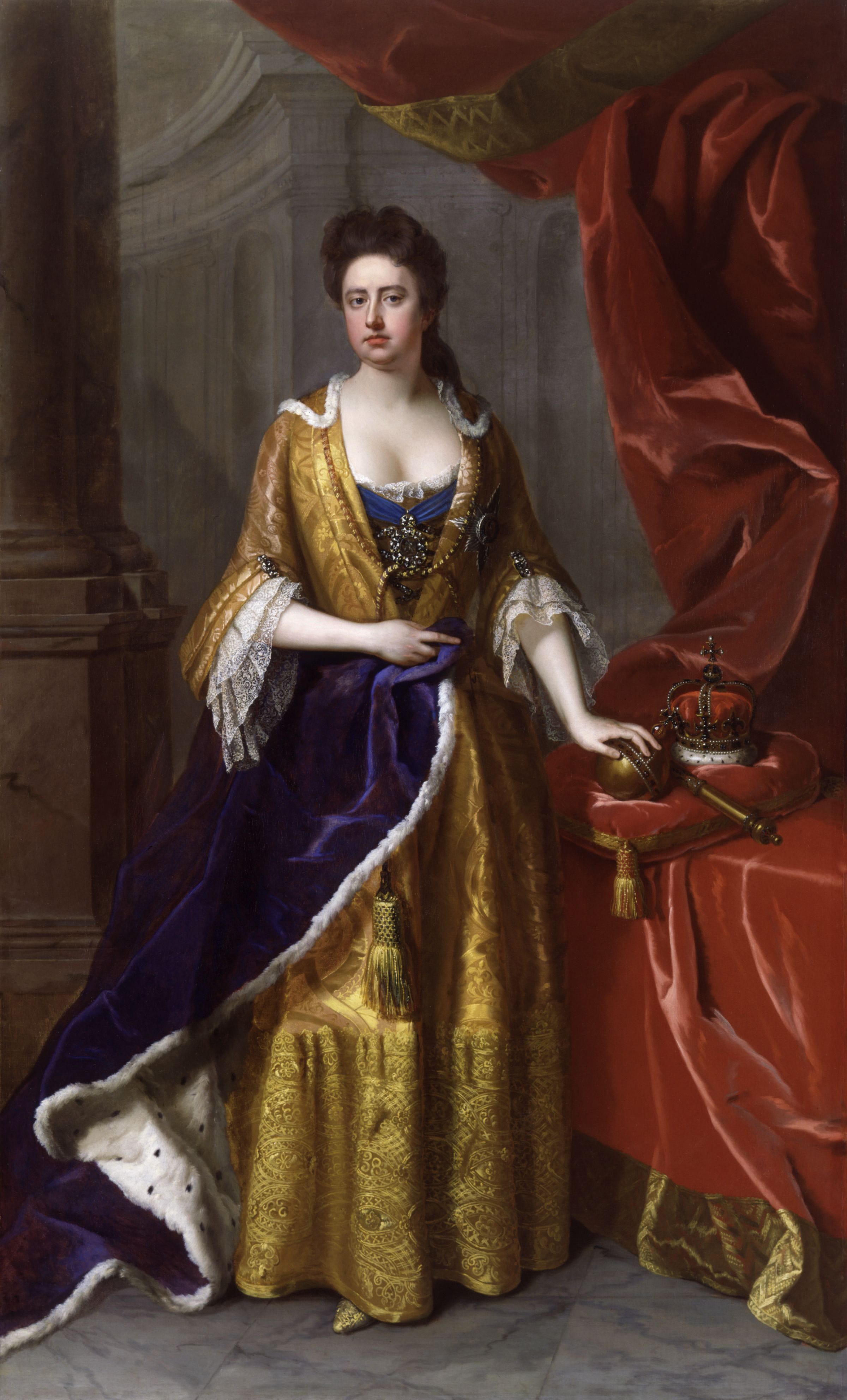
Good Queen Anne, by Michael Dahl
Our current president never enjoyed Tennyson and Yeats. I now see why he lacked taste for poetry (hint: ideology). And Marx came to roost after Winston Churchill so...