
Forever England, Forever Green
Why Britain Needs English Pastoral

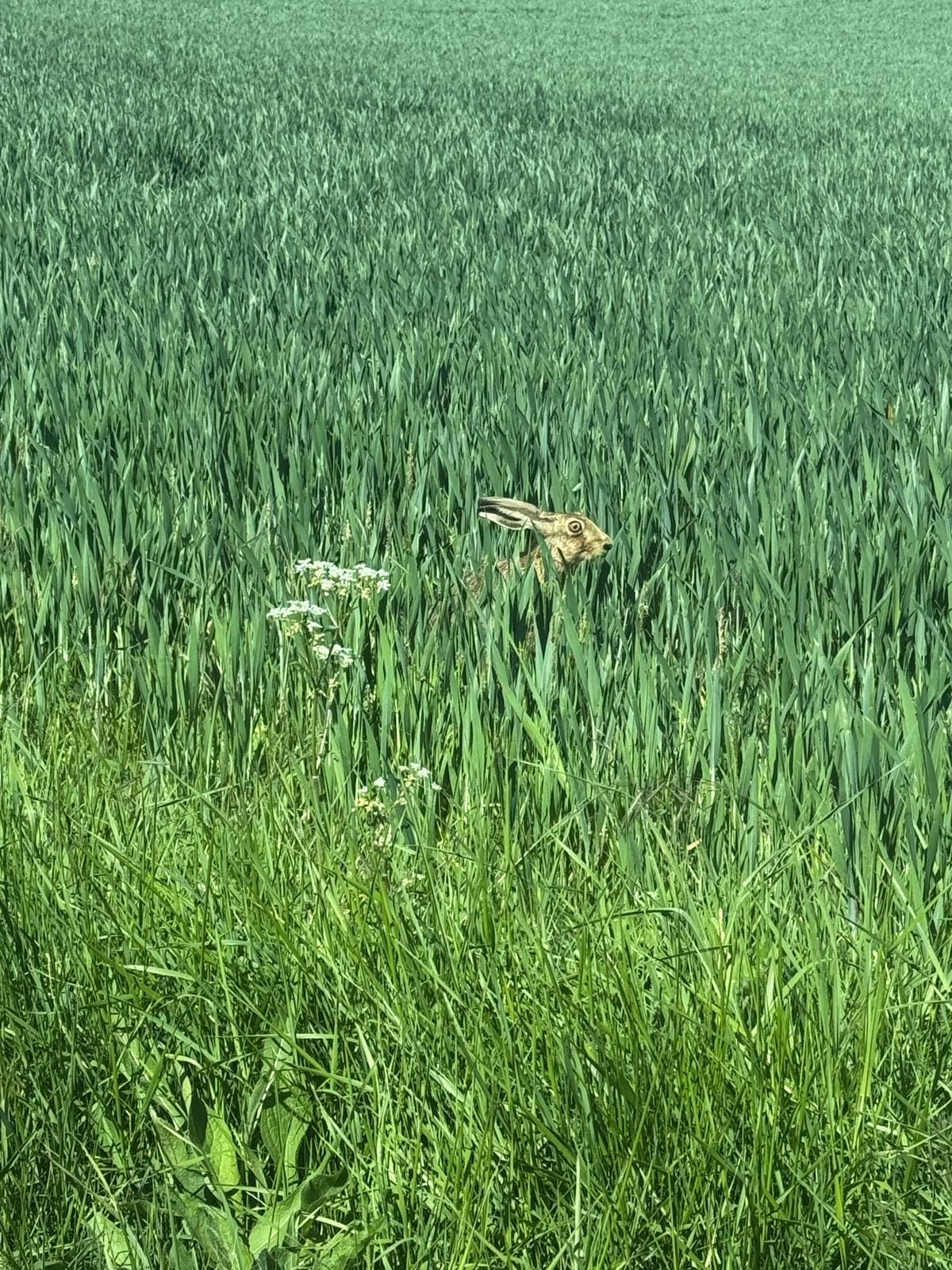
Hare in the corn, Norfolk, 2025
J. R. R. Tolkien’s essay, ‘On Fairy-stories’, published in 1964, but based on a lecture he gave in March 1939 at the University of St Andrews in Scotland, has much in it to reveal to us Tolkien’s profound thinking on the workings of the modern world, again descending, in 1939, into total war. I’ve mentioned before the radical distinction Tolkien makes in the essay between, on the one hand, Magic (including Science) and, on the other, Art, a distinction implicit in the lore of the Rings of Power in his own legendarium, and which reflects Tolkien’s traditional Catholic vision of the nature of reality. Tolkien contrasts his view of reality with what is commonly called, in the modern world, ‘real life’ – the materialist, urban, machine-world of modernity which most of us have to negotiate in our day-to-day working lives. ‘Reality’ and ‘real life’ are thus two quite different things. In the latter world view, we see Science and Technique (Magic in Tolkien’s mythology), used for the ‘domination of things and wills’; to the contrary, Art, the Elvish craft, works in harmony with the beauty of Creator and Creation: ‘Uncorrupted, it does not seek delusion, nor bewitchment and domination; it seeks shared enrichment, partners in making and delight, not slaves’. It is a distinction which, to extrapolate into the political sphere, we might bear in mind amidst our present discontents.
Another aspect of the modern conception of ‘real life’ that Tolkien critiques in the essay is that embodied is the contempt amongst the contemporary intelligentsia for fantasy fiction (that is, what Tolkien calls ‘fairy-tale’, or Tolkien’s own myth-making), condemned as ‘escapist’, and not worthy of serious critical or scholarly concern. While the burgeoning of Tolkien studies in more recent times has successfully thrown off the deadening hand of the academic establishment, which never had much purchase anyway in reforming the taste of Tolkien’s immense readership, there are still a significant number of readers and critics, some not without influence, who have a settled dislike for fantasy fiction in general and Tolkien in particular. The criticism is more likely nowadays to have shifted to political grounds, away from more strictly literary ones, as Tolkien is lumped with conservative, reactionary, nativist, racist, and populist outlooks, quite verboten among the bien pensants. Tolkien himself, however, in ‘On Fairy-stories’ shows a deeper understanding of the idea of escape than most of his critics.
Fairy-tale is condemned as ‘escapist’, but Tolkien welcomes the word, acknowledging that, ‘Escape is one of the main functions of fairy-stories’. He also says that, in some areas of ‘Real Life’, escape is a perfectly natural and rational thing to wish to accomplish: ‘Why should a man be scorned if, finding himself in prison, he tries to get out and go home?’ No, says Tolkien; the critics who talk ill of escapism are confused in their thinking and wording:
In using escape in this way the critics have chosen the wrong word, and, what is more, they are confusing, not always by sincere error, the Escape of the Prisoner with the Flight of the Deserter. Just so a Party-spokesman might have labelled departure from the misery of the Führer’s or any other Reich and criticism of it as treachery.
Tolkien suggests here that ‘escapist’ literature is, in this view, to be avoided because it does not follow the modern party-line of ‘realism’, a cultural consensus built on the ideological academy, still very much with us, and subsisting in Marxist, historicist, postmodernist, feminist, postcolonial, and psychological approaches to literature, which see human life purely in terms of materialist forces, structures of power, and a nominalist scepticism which leaves room only for the subjective. Fantasy is not just to be condemned as poor literature, implies Tolkien; it is its very metaphysics which is unacceptable, because it is an impediment to the anti-national values among the intelligentsia of his time, and ours:
Not only do they confound the escape of the prisoner with the flight of the deserter; but they would seem to prefer the acquiescence of the ‘quisling’ to the resistance of the patriot. To such thinking you have only to say ‘the land you loved is doomed’ to excuse any treachery, indeed to glorify it.
Tolkien’s mention of ‘Führers’ and ‘quislings’ (additions probably made in the course of 1943 revisions to his text) show how much he saw contemporary events in terms of his understanding of literature and myth. Those who inhabit ‘the real world’ think only power matters, and if they cannot wield it, they readily surrender to it, as the only ‘rational’ thing to do. But Tolkien, along with his legion of readers and admirers, knew that reality is so much more than power: it includes love, including of country.
If we refuse to accept incarceration in the physical, mental, and spiritual prison of the modern world, Tolkien shows us that it is perfectly natural to try to escape, and on this theme what he says about the literature of fairy-tale (fantasy and myth) is also true of pastoral, especially the English pastoral poetry, music, and painting of the twentieth century, which was also often dismissed as merely ‘escapist’. The first decade, broadly the Edwardian period of 1901 – 1910, was a time of immense cultural ferment in England, and a time of intense industrial development and commercial mass production. At the same time, this pre-war period was marked by an equally intense focus on what it was feared might soon be lost: rural England, its traditional and customary loyalties and folkways, the closeness to nature and animals, to healthy open spaces and fresh air. A. E. Housman and Thomas Hardy were the established interpreters of this older world, and their influence is strongly felt in the work of the new ‘Georgian’ poets (so-called because they corresponded with the new reign of George V, not because they spoke for farmers). The Britain of the industrial cities, and the widening Empire, had never been so rich and powerful, but it was the England of Housman and Hardy that the young men who went off to the trenches of Flanders carried in their pockets, into a peculiarly literary war.
Tolkien was of course one of those reading and writing soldiers whose English vision was to come face-to-face with modern industrialized warfare. The Georgians, principally Edward Thomas, and also Siegfried Sassoon, Isaac Rosenberg, and Rupert Brooke, are often looked down on as products of a conservative publishing project, as reactionary throwbacks, purveyors of a nostalgic Romanticism, populist and anti-modern, and best forgotten. But this is a superficial misreading. Arguably, their authentic native English verse endured longer than the literary modernism which is often (again, superficially) seen as their antithesis.
Literary modernism had largely faded by the middle of the twentieth century, and the younger poets, such as Philip Larkin and Ted Hughes, would take their inspiration from Hardy and Edward Thomas, rather than the early T. S. Eliot. This is also true of the ‘Celtic’ poets, such as R. S. Thomas and Seamus Heaney. In all these poets, writing in traditional English forms and idioms, the rural subject-matter and conventions of pastoral are never far away. Perhaps the greatest poet of twentieth-century English pastoral was the American, Robert Frost, the friend of Edward Thomas, and a major influence on him from their time together in Gloucestershire. But even in literary modernism we find strong pastoral elements. David Jones’s In Parenthesis, perhaps the greatest English poem of the Great War, might be called a modernist pastoral (with fairy-tale elements, too), and T. S. Eliot’s Four Quartets is deeply rooted in the English countryside. All this is to say nothing of the music of Ralph Vaughan Williams and the English pastoral school; nor of the paintings of Stanley Spencer, Eric Ravilious, and many others. English pastoral was found by all these artists to be a particularly fruitful way in which, artistically speaking, the increasingly obvious horror of modernity could be imaginatively engaged.
The ‘escape’ of fantasy literature works very much like the convention, in the pastoral mode, of the retreat – which may also be an escape or even an enforced exile. The world of the city, of work and business (negotium), the machinations of politics and law, is left behind in the recourse to the country place, the locus amoenus, and to its people and their pursuits, enjoyed as leisure (otium). Complexity is abandoned for simplicity, and the mental stress of urban confinement for the free rural life of the senses. Of course there’s a good deal of artifice, and the artificial, in the return to nature in pastoral, since it is often being enacted as play by sophisticated characters from the court and palace – or the academy and the office block. The shepherds in pastoral might be real enough, but the poet imagining their lives of love-filled idleness will be a sophisticate, who must at some point return to his place in town after his holiday. The variations of pastoral can include the idyllic (after Theocritus) and the more realistic (after Virgil), but Arcadia, however much a dream-world, is as deep in the human psyche as Eden, the land of the heart’s desire, a life in harmony with God and Creation. In England, however (and I suspect that this is more so than in many cultures, but pastoral of course has a wide human appeal), the idyll of country living has been seen as the national reality, rather than a desirable exception to the norm of the city; and this was even more so the case after England moved, across the course of the nineteenth century, from a country where most people lived in the country to one where most people lived in the city. We might justly say that Hardy’s Wessex and Housman’s Shropshire are countries of the mind, but they also correspond closely to real English geography and real rural experience, and it is a reality against which the promises of technological modernity are frequently seen as wanting – as actually unreal.
The presence of pastoral in English (and wider British) culture of the twentieth century is remarkably extensive, pervading art both higher and lower, from poetry and classical music, through English folk and rock music, film and TV. The ‘escape’ of English pastoral may be enjoyed (vicariously, as it were) through listening to ‘The Lark Ascending’ or watching the latest episode of Channel 5’s re-imagining of All Creatures Great and Small. The psychological experience to which pastoral art bears witness can also of course be enjoyed directly in life, through a walking tour, or a day’s outing to a National Trust country house, or even a house move to the country, in a radical readjustment of our approach to living. Pastoral easily lends itself (as perhaps fairy-tale doesn’t) to ‘real-life’ as well as artistic experience. In both art and life, pastoral helps us to make the recovery which Tolkien tells us, in ‘On Fairy-stories’, is also a function of fantasy:
Recovery (which includes return and renewal of health) is a re-gaining of a clear view. I do not say ‘seeing things as they are’ and involve myself with the philosophers, though I might venture to say ‘seeing things as we are (or were) meant to see them’ – as things apart from ourselves.
Whether through art or life, pastoral involves an encounter with the real, and an escape from the merely subjective. It is a metaphysical correction, a seeing of things – nature, creation, cosmos – as we are meant to see them. The return in pastoral – to health, or to our unavoidable social responsibilities in town or country – is the counterpart to the escape or enforced exile. This is why it is an artistic mode which has appealed to the English for hundreds of years (certainly since the Renaissance, but in some ways even earlier) as they attempt to make sense of immense social upheaval – the Black Death, the Reformation and Dissolution, the English Revolution and Civil Wars, Enclosures, the French Revolution and Napoleonic Wars, the Industrial Revolution, and World War. The pastoral mode is England’s perennial form of self-understanding. Britain may be, for good or ill, ‘real life’, but England is a deeper reality, in which we can ‘see things as we are meant to see them’.
The current debate about Britain, and about England, is connected to this deeper narrative in the past history of these islands, and it would do well to pay close attention to the use of pastoral in English culture of the twentieth century, as being particularly relevant, both close in time and intimately connected to the century from which we are still, in many ways, trying to escape. The tension in twentieth century English pastoral, between rural England and industrial Britain, still obtains in our post-industrial historical and geographical landscape; the Machines have merely taken on a new and more pervasive form, as Tolkien knew they would. Pastoral, like fantasy, is a gateway to the reality revealed in the mythological, the mystical, and the spiritual. There are still those today, therefore, who would like England, and everything English, to disappear, and a new Britain emerge fully formed, like the butterfly from the chrysalis, a modern country, a ‘Cool Britannia’, realizing itself in a utopia of diversity, equality and inclusion. It’s not actually that far away (being both forms of Liberalism) from the great imperialist and commercial project of the past, the Whiggism of global military, financial and commercial power, which gave us that interpretation of history as the march of Progress, and even looked to perfect itself, in time for the millennial year of 2000AD, in Fukuyama’s End of History. But 9/11 happened instead, and Liberalism is looking very uncertain now, in fact a rather ‘unreal’ construction, an abstract ideology of mere ‘values’, but which originated in English things which Liberalism, per se, cannot generate.
England, on the other hand, is increasingly looked upon as something real: organic, storied, and personal. I’ve said before that England inheres in three things: its Christian religion; its language and literature; and its natural and traditional built environment. I might also have added to the list England’s characteristic common law tradition (drawn from the Christian understanding of natural law), the lifeblood of its institutional and constitutional bodies, the embodiment of the tradition of ordered liberty and self-government, and ground of its ‘bottom-up’ restraint of power. Along with the monarchy (an institution which has less and less authority in modernity because it is rooted in something far deeper in history and pre-rational human experience), England’s institutions, law, religion, language, literature, and settlement itself was instrumentalized by British liberalism in a project which is now finally failing, as ‘tolerance’ is now being seen as potentially fatal neglect. But feeling itself cornered, Liberalism will continue to flail about, and sometimes violently. England nonetheless endures, but can Britain?
Britain is certainly worth saving, not least because the future of all the 75 millions of people of the British Isles, geographically as well as historically closely (if not always happily) interconnected, depend on Britain. More particularly, they depend on England, where 80% of British and Irish people live, and on the political traditions of which Britain was built. The British state (if it would only admit it) is miserably shrunk abroad, and it is to be hoped that it will one day seek to shrink at home, the Machine left to rust in the field, so that the native soil of custom, of folkways, of natural, human imagination and inventiveness can renew themselves, finally left to their own incalculable human gifts. England – along with Wales and Scotland, and perhaps Ireland, too – could then live and breathe again, and find their own future based in their own native virtue, in relationship with a Britain which would leave its people to their own considerable potential.
We can no more get rid of Britain than we can stop living in towns and cities, but we can return Britain to its land and its traditions, especially those of self-reliance and self-government. Pastoral can help in this renewal because it looks in the opposite direction to utopia, back to what has actually been, and is demonstrably real, rather than at what could conceivably be. This is the organic inheritance of English (and participative Irish, Scottish, and Welsh) creativity, in a country returned to the people and their ways, away from the confiscatory state machine. Pastoral knows that utopia will turn into dystopia when its imaginations become ‘real life’, because what began in a garden can only return to a celestial city, not an earthly Babel. As always, in its dream of the past, it points us to a more humane and realistic future, when the Shire is scoured.
Readers will I hope be interested to know that, just before Christmas, I signed a contract with Polity Press, Cambridge, and its senior editor, the estimable George Owers, to publish my new book, currently titled, in manuscript, Fields of Green: English Settlement and English Pastoral, in which I expand on some of the themes above. God willing, and depending on the speed of the publication process, the book will appear later this year or early next.
George Owers’s new book, The Rage of Party: How Whig Versus Tory Made Modern Britain (Constable) is much to be recommended.
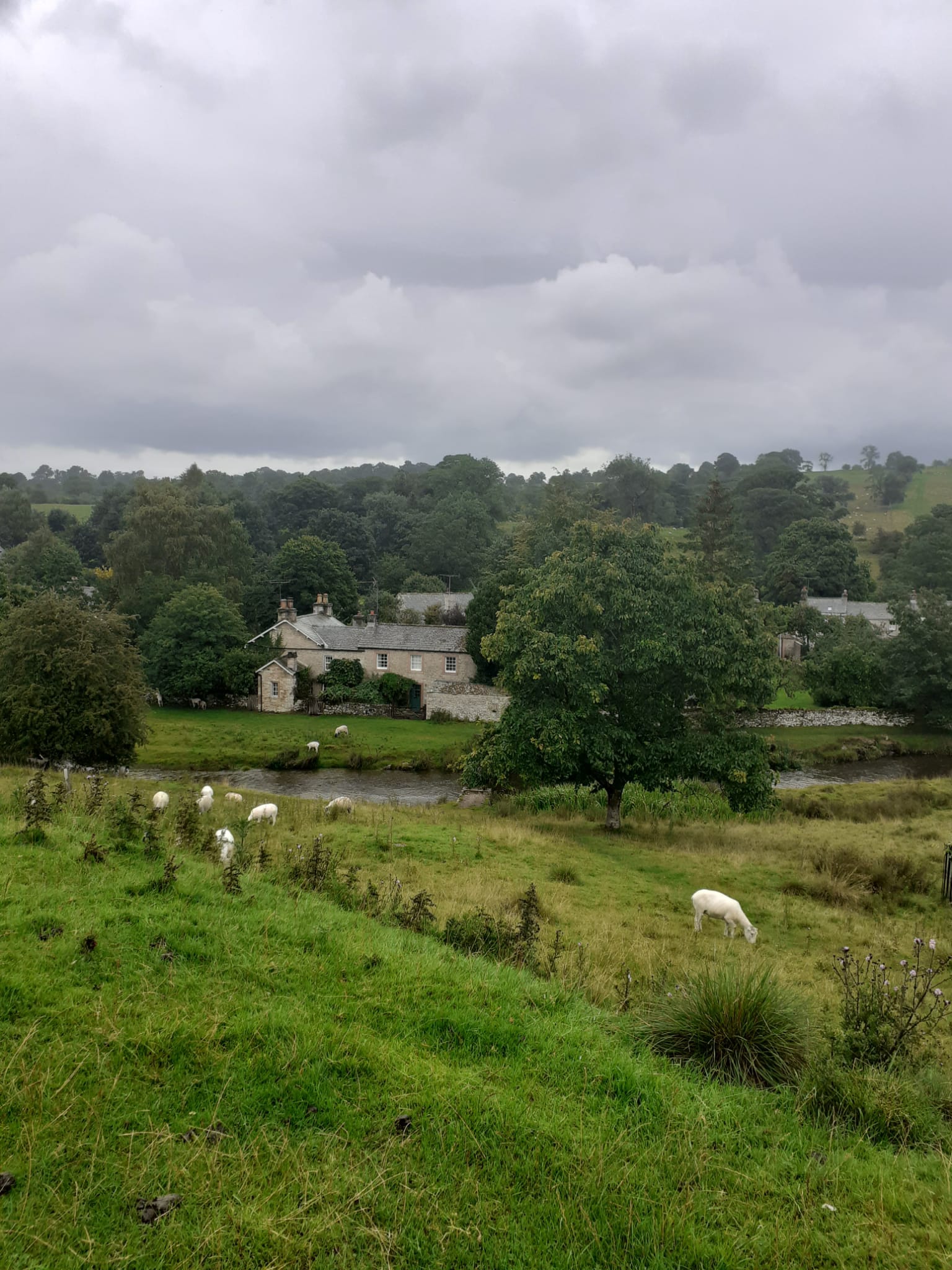
Maulds Meaburn, Westmorland, 2024
This is a great post and exciting news! I read your book, The Common Mind, several years ago and learned much from it. Some of the writers you mentioned (Edward Thomas, Siegfried Sassoon, etc.) I was not aware of, so now I have much more reading ahead.
The connection you make between agrarian themes grounding us in reality is one I've tried to make in my own writing and conversation. Thank you for your careful thought and for the work you put into this post.
Great post. I don't know whether the world will ever be weaned of modernism, but it is at least more systematic than postmodernism. To collect all lines of thought that correspond with the latter movement would be tedious. On the other hand however, I think it is proper to use postmodernism against modernism. I don't know, but it is perhaps true that there's so much that needs to be deconstructed in modernism. Tolkien isn't modernist by any standards, is he? Great writer. I don't claim to entirely know how postmodernism can be used as a positive force, but I will fall on Chesterton's line that in times of crisis it is not just vice that is unleashed but virtue that is put to wrong use, and thus wasted. In education, I tend to notice that the theme of 'de-colonisation' is common. But isn't postmodernism also a Trojan horse in some ways?